



In the evolving world of API design, choosing between GraphQL and REST can be a pivotal decision that impacts your application’s performance and scalability. While both have their unique strengths, understanding the nuances of each will help you tailor your API strategy to your project’s specific needs.
Understanding the Basics: What are GraphQL and REST?
Before we delve into the comparison, it’s essential to understand what GraphQL and REST bring to the table. REST (Representational State Transfer) is a traditional architectural style for networked applications, defined by its stateless, client-server communication model utilizing standard HTTP methods like GET, POST, PUT, and DELETE. On the other hand, GraphQL, developed by Facebook in 2012, offers a more flexible approach. It allows clients to request precisely the data they need, reducing over-fetching and under-fetching issues.
Key Differences: GraphQL vs REST
When comparing GraphQL and REST, several key differences stand out:
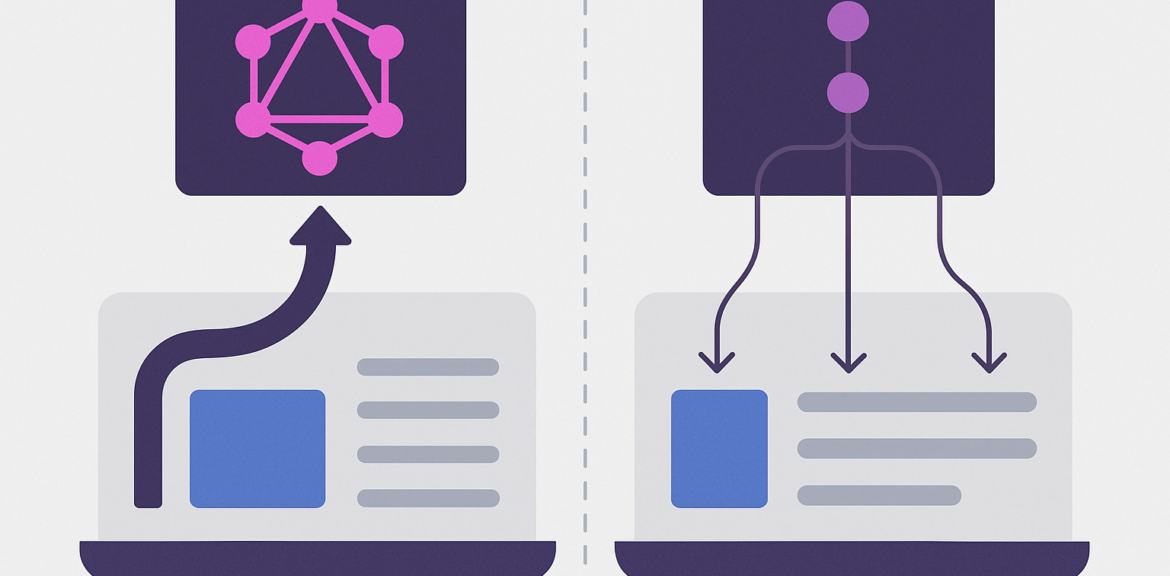
- Data Fetching: REST APIs often return fixed data structures, leading to over-fetching of data. GraphQL, however, allows clients to specify the exact data fields they need, improving efficiency.
- Flexibility: GraphQL offers a single endpoint for all data requests, while REST APIs typically involve multiple endpoints for different resources.
- Versioning: REST APIs may require versioning to handle changes in data structure, but GraphQL can evolve without multiple versions as clients define their query structure.
Benefits of Choosing GraphQL
GraphQL provides several compelling benefits that make it an attractive choice for modern applications:
- Efficient Data Loading: Clients receive only the data they request, reducing the payload size and speeding up data retrieval.
- Rapid Prototyping: Developers can quickly iterate and modify data queries without waiting for backend changes.
- Strongly-Typed Schema: GraphQL’s type system ensures more predictable results and better documentation.
Considerations for Using REST
Despite GraphQL’s advantages, REST remains prevalent for a variety of reasons:
- Simplicity: REST APIs are straightforward to implement and understand, especially for simple CRUD operations.
- Caching: HTTP caching mechanisms are natively supported with REST, enhancing performance for read-heavy applications.
- Maturity and Support: REST has been around longer, resulting in robust tooling and community support.
When to Choose GraphQL vs REST
Deciding between GraphQL and REST often depends on your project’s specific needs and constraints. If your application demands precise data fetching and the flexibility to adapt quickly without backend changes, GraphQL can offer significant advantages. Conversely, if you prioritize simplicity, straightforward caching, and established support, REST might be the more suitable choice.
Moreover, consider the team’s expertise and the existing infrastructure. For a team well-versed in RESTful design with applications that require stable, predictable structures, sticking with REST can be beneficial. Meanwhile, for projects needing rapid evolution and complex data relationships, GraphQL could be the way forward.
Key Takeaways
- GraphQL offers flexibility and precise data retrieval, reducing over-fetching issues.
- REST provides simplicity and robust caching capabilities out of the box.
- Choose GraphQL for applications requiring dynamic queries and frequent front-end changes.
- Opt for REST if you need a mature, well-supported system with straightforward CRUD operations.
Ultimately, the choice between GraphQL and REST should align with your project’s goals and long-term vision. Each has its role and can deliver great results when applied appropriately. Weigh your options carefully, and you’ll be equipped to make a decision that best serves your application’s needs.
Frequently Asked Questions
- What is the main difference between GraphQL and REST?
-
The main difference is that REST uses multiple endpoints for different resources, while GraphQL uses a single endpoint that allows clients to specify exactly what data they need.
- Why might someone choose GraphQL over REST?
-
GraphQL allows precise data fetching and has a flexible query system, which can reduce the amount of data transferred and make applications more efficient.
- Is REST still relevant in modern API development?
-
Yes, REST remains highly relevant due to its simplicity, robustness, and widespread support, especially for straightforward CRUD operations.
- Can GraphQL and REST be used together?
-
Yes, they can be used together. Some architectures use GraphQL as a gateway to aggregate data from multiple REST APIs, leveraging the strengths of both.